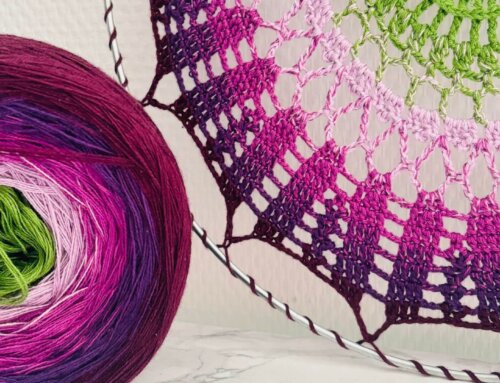
Wasting yarn unnecessarily can almost feel like a “rat race.” Why? Have you ever played the game “Yarn Chicken”? When starting a new project where tension is important, sometimes you have to waste a bit of yarn. Again, why? What to do about your crochet or knitting tension, darling? You don’t want your sweater to end up too big or your blanket too small, right? Today we’re going to talk about the big, fluffy yarn elephant in the room: what to do about your yarn tension.
Crochet and knitting are crafts meant for relaxation at the end of the day. For me, it’s a form of relief after a long workday. Just counting, placing my stitch marker, and checking off that one row. For some projects, you don’t really need to worry about tension. For amigurumi, it’s important that the stitches are close together. If the holes are too big, grab a smaller hook. But there are projects where tension really matters, like fashion items or blankets.
Tension is Key
The game “Yarn Chicken” is one of many that we knitters and crocheters play. You look at your yarn ball and wonder if you’re going to make it. Sounds familiar, right? The reason I never make a tension swatch is fear of “Yarn Chicken.” But, a big BUT: for making a fashion item, you do need that tension swatch. If your tension is too loose, your sweater could suddenly end up an XXL. If it’s too tight, that gorgeous sweater could shrink to a child’s size instead of a standard size M. The tension swatch is meant to compare your hand to the designer’s. If you’re short a few centimeters or inches, use a larger hook or needle. If it’s too big, go one size smaller.
Yes, yes… tension
Yes, tension. We all hold our yarn differently, and our techniques can vary. If you’re someone who does “Yarn Under,” you might need a different hook. The stitches from the “Yarn Under” technique are tighter than the “Yarn Over” technique. The same item can vary in size depending on which technique you use compared to what’s described.
How we hold our yarn differs from person to person. Some wrap it around a finger multiple times. I, for example, wrap it once around my pinky to maintain tension. But if the yarn is smooth, like velvet, I wrap it around two fingers to keep the tension consistent. Even if you do it the same way I do, our tension can still vary. That’s why—a fact I hate to admit—a tension swatch is so important for larger projects.
So put the thought of “Yarn Chicken” aside. Make the tension swatch as intended and pay close attention to how you hold your yarn. Don’t change it midway through your project, as it can throw off your measurements. Stick with your choice throughout the entire project.
What if I don’t have enough yarn for my project?
Running short on yarn for your project? Make the tension swatch using that yarn. Trust me, you won’t see the difference in the yarns I’ve used. It’s only confusing for you, not for the final result. Make the swatch loose if you need the yarn. But it’s best to make sure you have enough yarn before you start. And pay close attention to color lots! A blog post about this topic is coming soon, so stay tuned!